Aluminum Pergolas in Arizona | Cost, Styles & Care
Aluminum Pergolas in Arizona: What Homeowners Should Know Before Buying
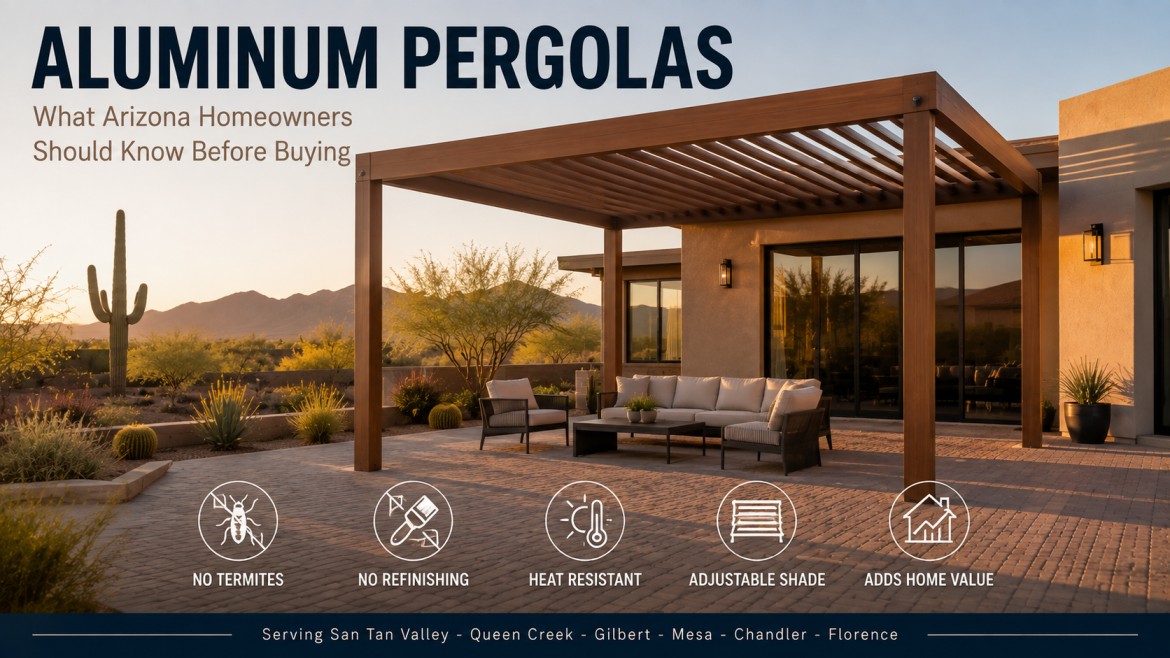
Quick Answer: An aluminum pergola is an open-roof shade structure built from powder-coated extruded aluminum rather than wood. In Arizona it outlasts timber by decades — no warping at 115 degrees, no termites, no refinishing. Expect filtered shade from fixed slats, or full adjustable coverage from a louvered roof you open and close by remote.
What Is an Aluminum Pergola, and How Is It Different From a Patio Cover?
A pergola is defined by its roof — or rather by the fact that it doesn't have a solid one. Instead of continuous panels, spaced rafters and slats run overhead, so light and air pass through.
An aluminum pergola takes that classic form and builds it from extruded, powder-coated aluminum instead of timber. From the street the proportions look the same. What changes is everything you cannot see from the street: how it behaves in July, how it looks in year ten, and how many weekends it asks for.
The line between a pergola and a patio cover blurs in conversation, and it is worth being precise because they solve different problems. A patio cover means full shade and rain protection. A pergola means filtered light, airflow, and architectural presence. If you want to eat outside during a monsoon downpour, you want a cover. If you want dappled light over a seating area, a garden path, or a pool deck, you want a pergola.
The exception is a louvered pergola, which lives in both camps. Rotating aluminum blades let you run it open on a mild March evening and closed when a storm arrives, so one structure covers both jobs.
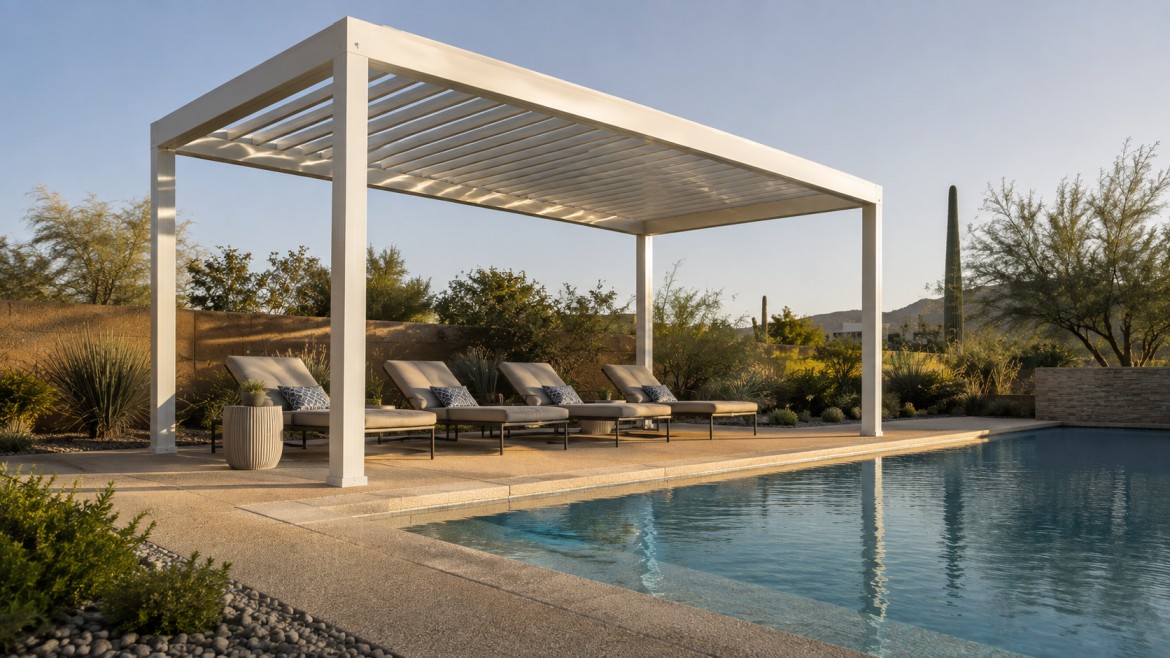
Freestanding versions anchor a spot away from the house. Attached versions tie into the fascia and read as an extension of the roofline.
Why Do Aluminum Pergolas Outperform Wood in the Arizona Climate?
Arizona is unusually hard on exposed timber, and the failure modes are predictable.
Ultraviolet exposure comes first. Sun at this latitude breaks down the surface of bare and stained wood, greying it and raising the grain. A stained wood pergola in Queen Creek or Gilbert needs refinishing every two to three years to stay presentable, and skipping a cycle means the finish stops protecting, not just stops looking good.
Heat cycling comes second. Days above 110 followed by nights in the 80s move wood constantly. Across a few seasons that shows up as checking, splitting around fasteners, and beams that no longer sit true.
Termites come third, and they are not hypothetical here. Subterranean termites are widespread across the East Valley, and untreated posts in ground contact are exactly what they look for.
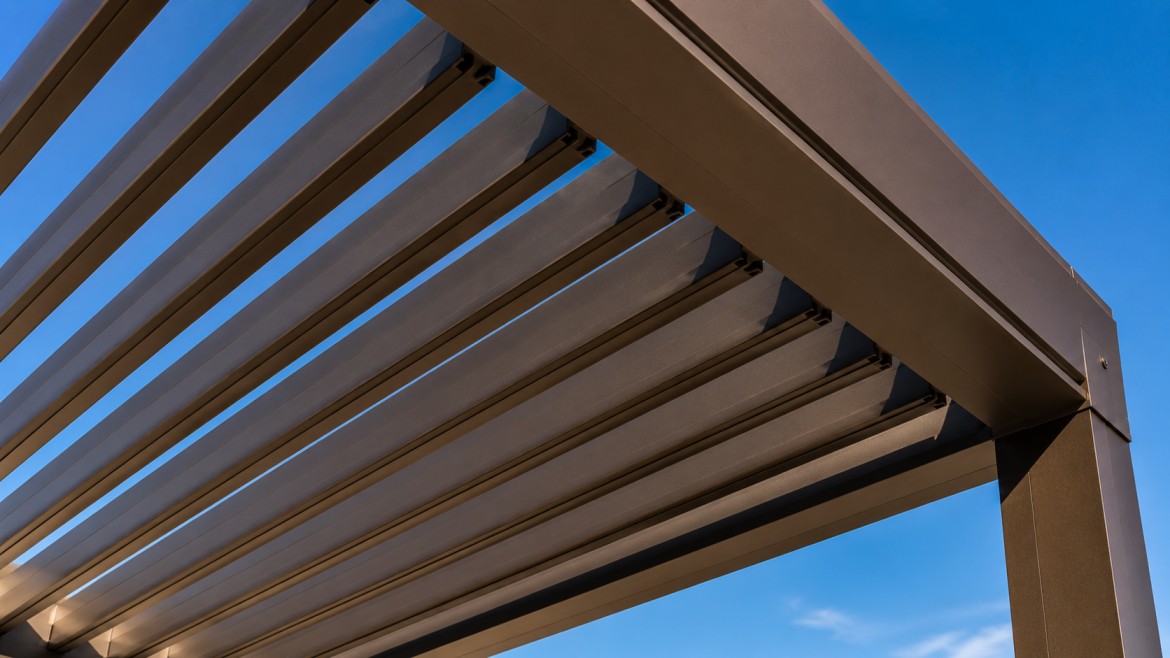
Aluminum pergolas sidestep all three. The powder-coated finish is baked on rather than brushed, so it does not peel or need recoating on a schedule. Aluminum does not feed insects. And it does not swell and shrink with temperature the way timber does.
One honest trade-off: aluminum conducts heat, so a beam in direct sun is warm to the touch, the same as any metal outdoors. Because a pergola is mostly open it does not radiate downward the way a solid roof can, but it is worth knowing before you lean on a sunlit post in August.
Which Aluminum Pergola Style Fits Your Backyard?
Four decisions cover most projects.
Fixed-slat pergolas carry evenly spaced blades in a permanent position. Shade depends on spacing and on where the sun sits — generous at midday, thin in late afternoon. Simplest and most affordable.
Louvered pergolas carry rotating blades, usually motorised with a remote. Full shade on demand, open sky when you want it, and closed against rain. The premium option and the most versatile in this climate.
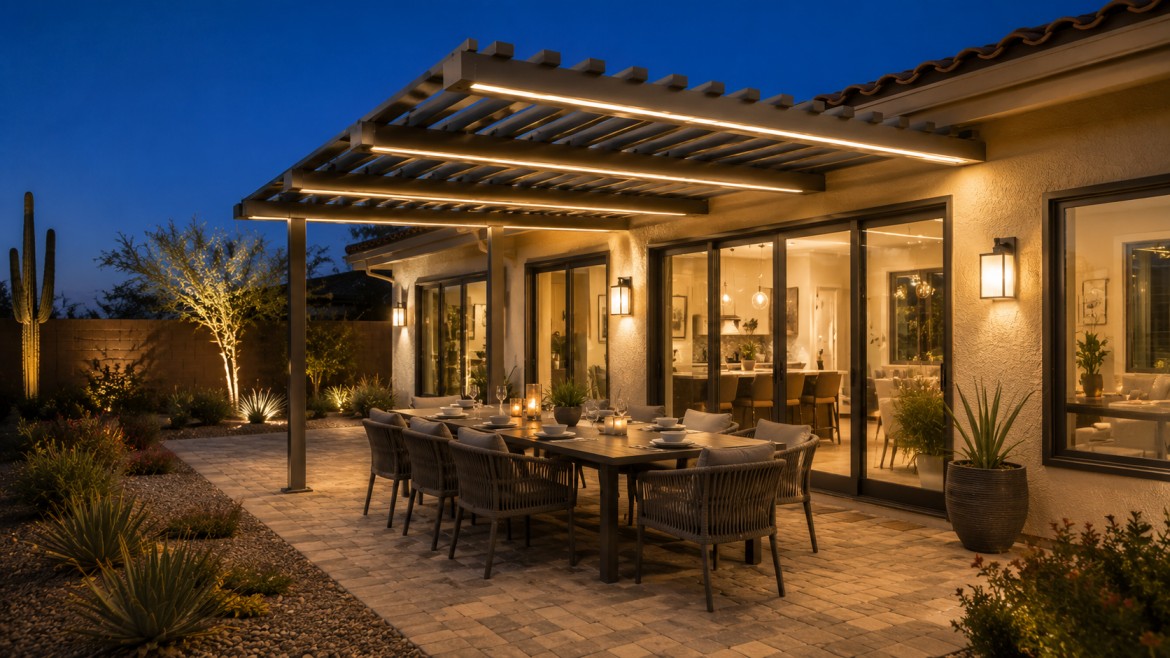
Attached pergolas fasten to the fascia or wall and need only two outer posts, which suits shallow patios where floor space is scarce.
Freestanding pergolas stand on their own four posts anywhere in the yard — over a pool deck in Gold Canyon, beside an outdoor kitchen in Chandler, or as a destination at the far end of a lot.
Colour matters more than homeowners expect. Powder coating comes in a wide range, and wood-grain finishes are convincing enough at conversational distance that most visitors assume timber. Darker finishes read as more contemporary and run hotter to the touch; lighter finishes stay cooler and reflect more light down onto the patio.
Still weighing a pergola against a solid roof? Browse our homeowner guides and project stories — the pergola versus patio cover comparison covers that decision in detail.
What Does Installation Involve, and Do You Need a Permit?
Usually yes, and that is a good thing rather than an obstacle.
Most Arizona jurisdictions require a building permit for any structure attached to the home regardless of size, and for freestanding structures at or above 200 square feet. Municipalities across Maricopa County generally require these structures to be engineered for a 115 mph ultimate design wind speed under ASCE 7-16 and the 2021 building code — a figure set with monsoon microbursts in mind.
Footings are where the engineering shows up. Chandler, for example, specifies a minimum footing of 18 inches square and 12 inches deep below grade. Post bases must reach undisturbed soil, which on an existing slab means coring through and pouring proper piers rather than bolting to thin concrete.
The build itself is quick. After design, engineering, and approvals, a typical aluminum pergola goes up in two to four days: footings and post bases, then beams, then slats or louvers, then trim and any electrical for fans and lighting. Most of the calendar time is permitting and HOA review, not construction.
A licensed pergola contractor in Queen Creek should handle the engineering stamp, the submittal, inspections, and the HOA architectural packet. If a bidder suggests skipping the permit to save time, that is the bid to walk away from.
How Much Maintenance and Long-Term Value Should You Expect?
Close to none, which is most of the point.
Annual upkeep on a quality aluminum pergola amounts to rinsing the slats with a hose, wiping the posts, and checking fasteners once a year — call it an hour. Compare that with sanding and restaining a timber structure every second or third summer, in a climate where that work happens either in spring or not at all.
Longevity follows from the same properties. With no rot, no insect damage, and a baked-on finish, a properly engineered aluminum structure is a multi-decade asset rather than a ten-year one. Warranty terms are worth reading closely here: coverage on both materials and labour is what separates a purchase from an investment.
On resale, permanent outdoor structures behave differently from furnishings. A permitted, engineered custom pergola appears in listing photos and stays with the house. Shade sails, umbrellas, and portable screens leave with you. Buyers touring homes in Mesa, Florence, and Casa Grande in June are running one calculation — can I use this yard — and a real structure answers it.
Not sure whether a pergola or a solid cover fits your yard better? Schedule a free consultation and estimate and we'll walk the space with you and price both.
Frequently Asked Questions
How long do aluminum pergolas last in Arizona?
Decades, when engineered and installed properly. Aluminum does not rot, warp, or feed termites, and a baked-on powder-coated finish resists Arizona UV far longer than brushed paint or stain. The limiting factor is usually the quality of the footings and fasteners rather than the aluminum itself, which is why permitted installation matters.
Do aluminum pergolas provide enough shade for Arizona summers?
A fixed-slat pergola gives filtered shade rather than full coverage, which suits spring and fall better than July. Louvered pergolas solve this — closing the blades delivers near-complete shade on demand. Many East Valley homeowners choose louvered over a main seating area and fixed slats over gardens or pool decks.
Are aluminum pergolas more expensive than wood?
Aluminum typically costs more upfront and less over time. Wood needs refinishing every two to three years in this climate, and replacement comes far sooner. Factor in a decade of labour, stain, and eventual repairs and aluminum is usually the cheaper structure — with far fewer weekends spent maintaining it.
Do you need a permit for a pergola in Arizona?
In most cases, yes. Structures attached to the home generally require a building permit regardless of size, and freestanding pergolas typically require one at 200 square feet or larger. HOA architectural approval is separate and usually required too. A licensed contractor should handle both processes for you.
Can an aluminum pergola be attached to my house?
Yes. An attached pergola fastens to the fascia, wall, or roof structure and carries its outer edge on two posts, which saves floor space on a shallow patio. The connection must tie into real structure with proper flashing — fasteners driven into stucco alone are the most common installation failure we get called to fix.
