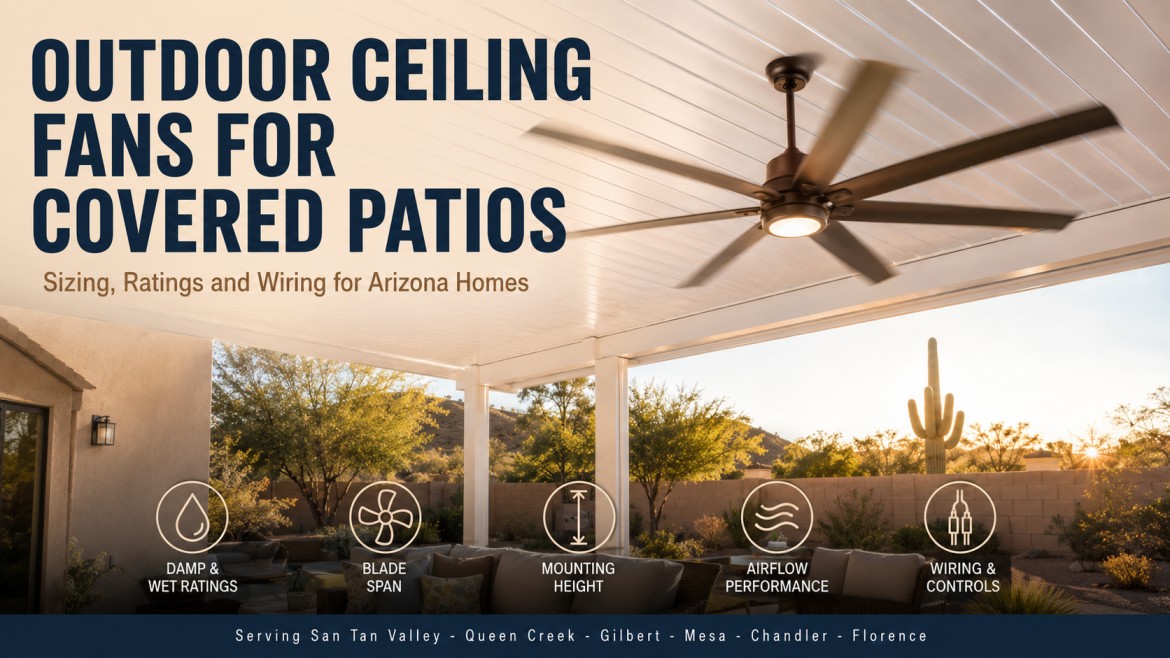
Outdoor Ceiling Fans for Covered Patios in Arizona
Outdoor Ceiling Fans for Covered Patios: An Arizona Guide
Quick Answer: A covered patio needs a damp-rated fan at minimum, wet-rated if rain reaches it. Size the blade span to the area — 44 inches for a 144 to 225 square foot patio, 50 to 54 inches above that. Mount blades 8 to 9 feet above the floor, and wire it during the build.
Do You Need a Damp-Rated or Wet-Rated Fan?
This is the first decision and the one people get wrong, usually by buying an indoor fan.
An indoor ceiling fan on a covered patio will fail. Humidity, blowing dust, and heat cycling get into a motor that was never sealed for it, and the blades warp. It is not a matter of whether — only how many seasons.
Damp-rated fans are built for covered outdoor spaces where no rain, snow, or ice makes direct contact. For a typical solid patio cover with reasonable roof coverage, this is the correct rating.
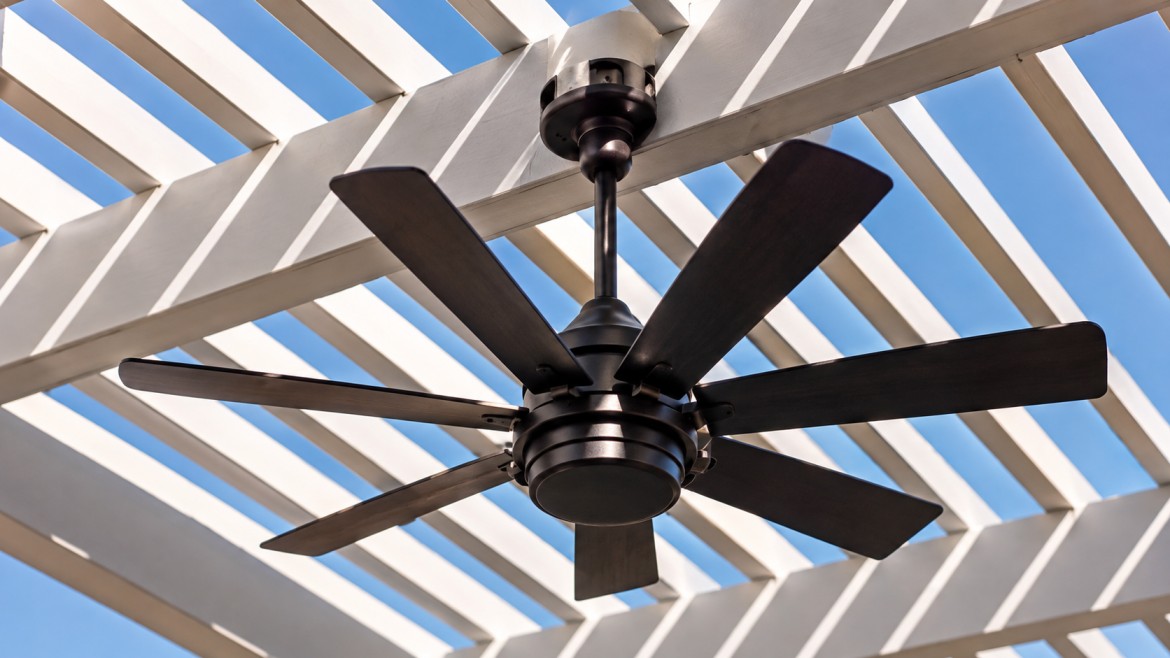
Wet-rated fans withstand direct water contact, with moisture-resistant motors and durable blades. These are what a pergola, a lattice structure, or a gazebo needs — anywhere rain reaches the fan.
The Arizona nuance is that "covered" is less absolute than it sounds. Monsoon rain arrives sideways, and an open-sided patio with a ten-foot projection gets wet along its edges even under a solid roof. If your fan sits within a few feet of the open edge, wet-rated is the safer specification even though the roof above it is solid.
Under a lattice patio cover or a pergola, the answer is simply wet-rated. Those roofs are designed to let things through.
What Size Fan Does Your Covered Patio Need?
Blade span follows the area you are trying to move air across, and the standard sizing guidance runs roughly like this:
Up to 75 square feet — a 29 to 36 inch blade span.
76 to 144 square feet — 36 to 42 inches.
144 to 225 square feet — 44 inches.
225 to 400 square feet — 50 to 54 inches.
One Arizona-specific adjustment: size up rather than down. Outdoor air is not contained the way a room is, so airflow dissipates instead of circulating. You generally want more movement outdoors than you would for an indoor room of the same footprint, and on a hot still evening the difference between an adequate fan and a generous one is obvious.
For patios beyond about 400 square feet, two fans usually beat one large one. A single fan at the centre of a long covered patio leaves the ends still, while two spaced across the run cover the whole area and let you run only the half you are using.
Airflow is often listed as CFM on the spec sheet, and higher is generally better outdoors. Between two fans of the same blade span, the CFM figure is the one worth comparing.
How High Should an Outdoor Ceiling Fan Be Mounted?
Higher than you might guess, and there is a safety floor as well as a comfort target.
The minimum is blades at least 7 feet above the floor. That is the safety standard and it is not negotiable, particularly on a patio where people stand up from seating and children play. Below that you have a hazard rather than a fan.
The comfort target is higher: blades around 8 to 9 feet above the floor generally give the best airflow feel. Too low and the air hits you in a narrow column; too high and it dissipates before it reaches you. Also keep blade tips at least 18 inches clear of any wall or post.
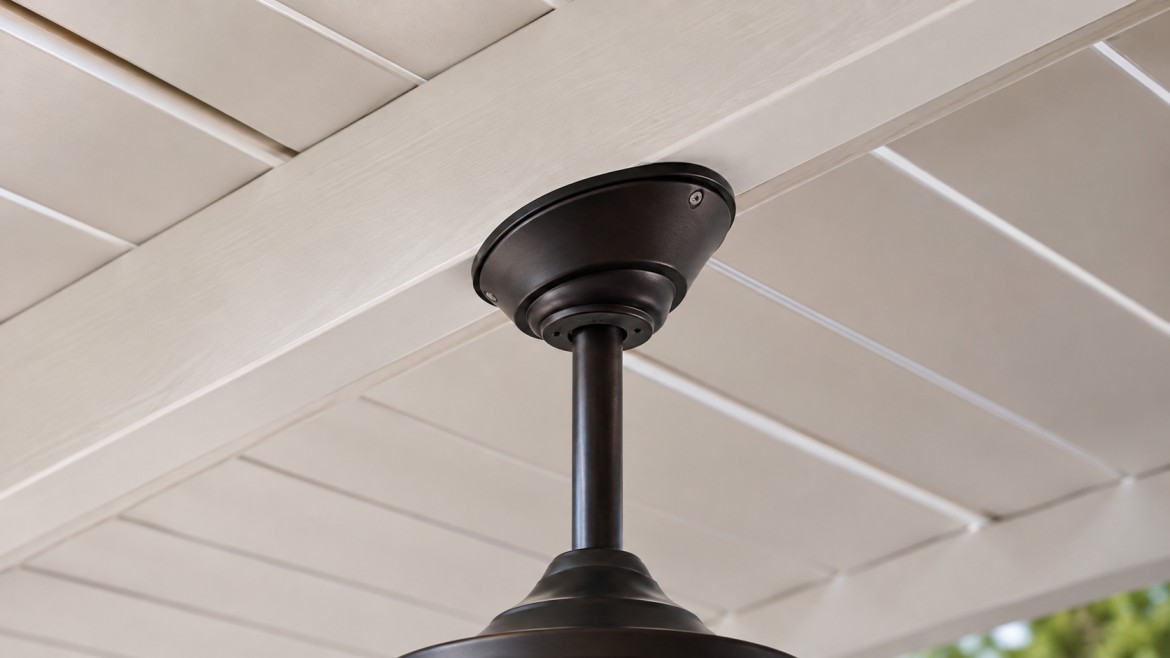
Downrod length works backwards from that. Decide your target blade height, measure from the finished patio surface to the underside of the beam or roof where the fan mounts, and let the difference determine the downrod. On a standard-height aluminum patio cover that is often a short rod or a flush-mount; on a high gabled ramada it can be considerably longer.
Sloped roofs need attention here. A pitched patio cover requires a downrod and canopy rated for the angle, and the mounting point has to land on structure rather than on a panel.
Planning what goes under a new cover? Browse our homeowner guides and project stories for how we approach lighting, fans, and electrical during a build.
Why Is It Cheaper to Wire Fans During the Build?
Because the structure is open, and afterwards it is not.
During construction, conduit runs inside beams and down through posts before panels go on. Nothing is visible in the finished result, the electrical rough-in happens alongside work already scheduled, and it gets inspected as part of the same process.
Retrofitting into a finished cover means opening up beams that are already trimmed and sealed, or accepting surface-mounted conduit that every guest will notice. Neither is a disaster, but both cost more and look worse than doing it at the outset.
The advice we give every customer is the same: even if you are not buying fans now, run the wiring and set the boxes during the build. The incremental cost while the structure is open is small, and it leaves you the option. Homeowners who skip it in Queen Creek and Gilbert routinely come back within two summers.
The same logic covers recessed lighting and outlets. Decide the electrical plan when you decide the structure, not after the first hot evening under it.
Fan mounting boxes also need to be rated for the weight and motion of a fan rather than a light fixture. That is easy when the framing is exposed and awkward when it is not.
How Much Difference Does a Patio Fan Actually Make?
Enough that most homeowners rank it above lighting as the best money spent under a cover.
A fan does not lower air temperature. What it does is move air across your skin, which accelerates evaporation and makes the same temperature feel meaningfully cooler. On a still Arizona evening — after sunset when the slab is still giving back heat — that difference is the gap between sitting outside and going in.
There is an indirect benefit indoors too. SRP notes that for every degree you set your thermostat above 80, you can save roughly 2% to 3% on cooling costs. A comfortable shaded patio with moving air is what makes a higher indoor setting tolerable, because the family is outside using it rather than in the living room.
Fans also do something useful under a solid roof: they break up the pocket of hot air that collects beneath a cover on a windless day. Under an uninsulated pan roof in particular, where the panel itself radiates heat downward, air movement is doing real work.
Pair a fan with an insulated patio cover and the effect compounds — one stops the radiant heat, the other moves what is left.
Building a cover and want the electrical planned properly from the start? Schedule a free consultation and estimate and we'll design it around how you'll actually use the space.
Frequently Asked Questions
Can I use an indoor ceiling fan on a covered patio?
No. Indoor fans are not sealed against humidity, blowing dust, or Arizona heat cycling, and the motor fails and the blades warp within a few seasons. Use a damp-rated fan for a covered patio with good roof coverage, or a wet-rated fan anywhere rain can reach it.
What size ceiling fan do I need for my patio?
Match blade span to area: 29 to 36 inches up to 75 square feet, 36 to 42 inches for 76 to 144, 44 inches for 144 to 225, and 50 to 54 inches for 225 to 400. Size up rather than down outdoors, since air dissipates instead of circulating. Above 400 square feet, use two fans.
How high should a patio ceiling fan be mounted?
Blades must sit at least 7 feet above the floor for safety, and 8 to 9 feet generally gives the best airflow feel. Keep blade tips at least 18 inches from walls and posts. Choose your downrod by working backwards from the target blade height to your actual mounting point.
Do I need a damp-rated or wet-rated fan under a pergola?
Wet-rated. A pergola or lattice patio cover has an open roof by design, so rain reaches the fan directly. Damp-rated fans are only for covered spaces where water makes no direct contact. On an open-sided patio, wet-rated is also safer near the edges where monsoon rain blows in.
Should I wire for ceiling fans even if I am not installing them yet?
Yes. Running conduit and setting rated boxes while the structure is open costs a fraction of retrofitting into finished, sealed beams later. It also avoids surface-mounted conduit. Most homeowners who skip it end up wanting fans within two summers, and by then the cheap window has closed.
