Patio Cover Roof Options in Arizona: Which Is Best?
Patio Cover Roof Options in Arizona: Solid vs. Lattice vs. Louvered vs. Insulated
Quick Answer: The best patio cover roof for an Arizona backyard depends on how you want to use the space. Solid roofs provide dependable shade and rain protection, lattice covers allow more filtered sunlight, louvered systems offer adjustable control, and insulated roofs provide greater heat protection. Your home's architecture, backyard orientation, HOA requirements, and budget should all factor into the decision.
What Are the Main Patio Cover Roof Options in Arizona?
Choosing a patio cover usually starts with one simple question: how much shade do you actually want?
That question matters in Arizona because a backyard that feels pleasant in the morning can become almost unusable by mid-afternoon. The right roof design needs to account for the sun, the direction your patio faces, how much rain protection you want, and whether the space is primarily for dining, entertaining, relaxing, or simply getting outside without standing in direct heat.
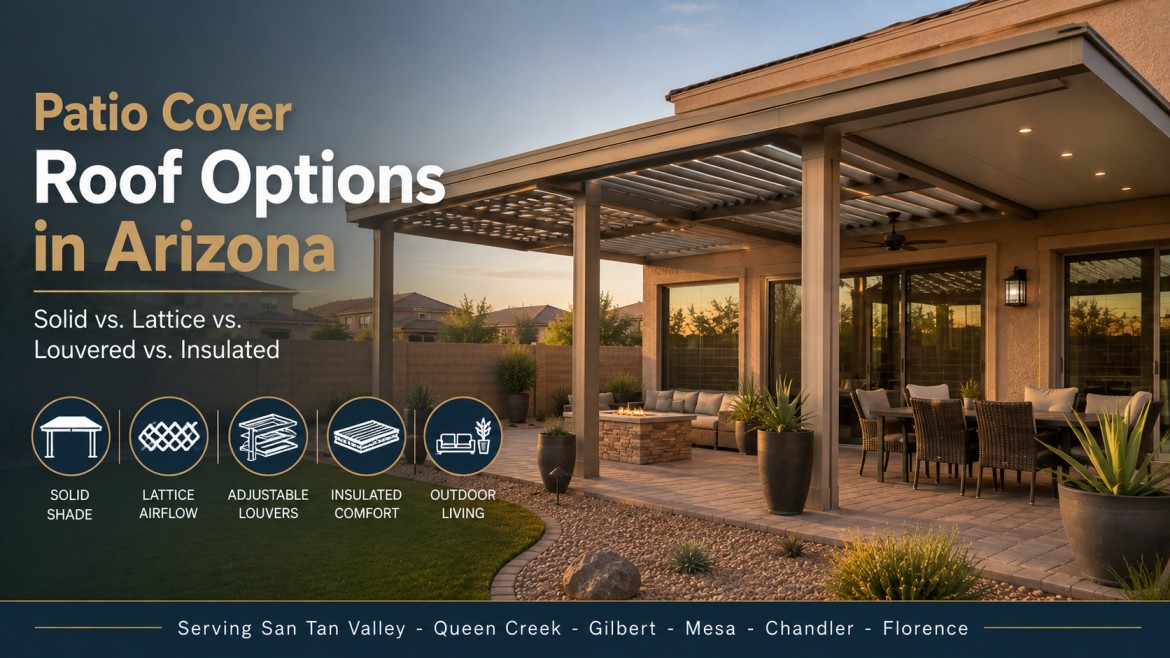
The most common patio cover roof options in Arizona include solid, lattice, louvered, and insulated designs. Each solves a slightly different problem.
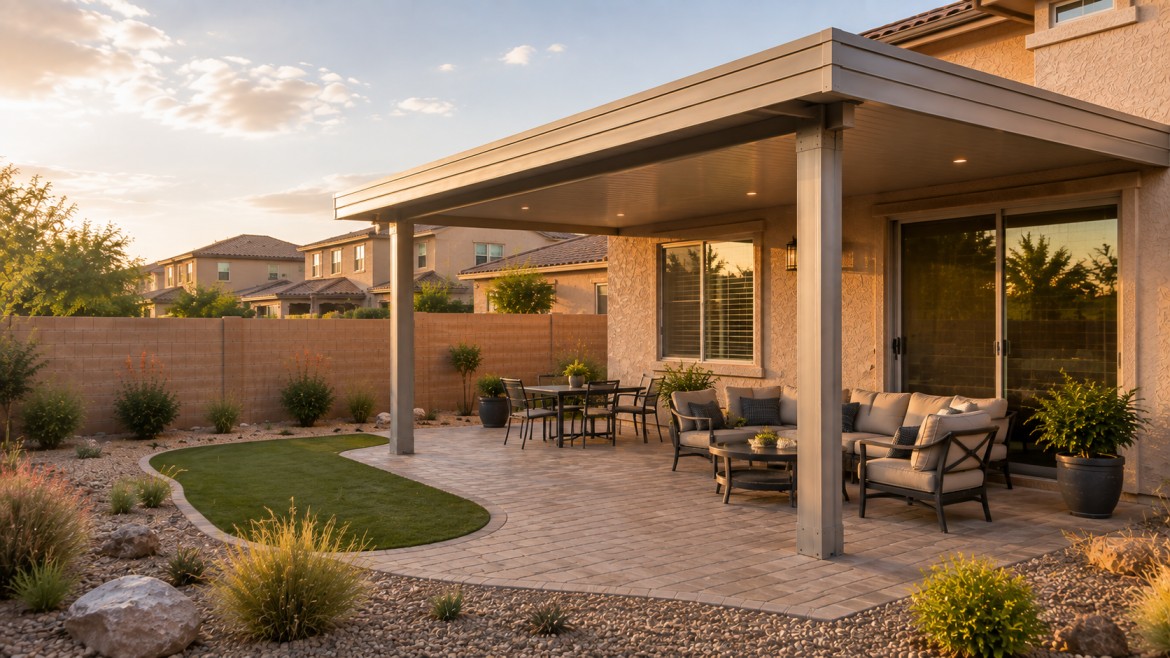
A solid patio cover creates a continuous roof overhead. It provides substantial shade and protects furniture and people from direct sunlight while also offering considerably more rain protection than an open design.
A lattice patio cover uses a spaced roof pattern that allows portions of sunlight through. It can create a lighter, more open appearance and work particularly well when homeowners want some shade without completely blocking the sky.
A louvered patio cover uses adjustable blades. Depending on the system, the louvers can be positioned to control sunlight, ventilation, and rain exposure throughout the day.
An insulated patio cover uses insulated roof panels designed to reduce heat transfer through the roof. This can be especially useful when the goal is to make the covered area feel more comfortable during the hottest part of an Arizona summer.
BCE currently offers these styles along with custom patio-cover solutions, so homeowners can design around the actual backyard rather than forcing every property into the same roof configuration.
If you're still deciding whether adding a cover makes sense for your property, see our guide to whether patio covers are worth it for Arizona homeowners.
How Does a Solid Patio Cover Perform in an Arizona Backyard?
For homeowners who want dependable shade, a solid roof is often the most straightforward solution.
The biggest advantage is consistency. Once the sun moves across the backyard, the roof continues doing its job. You are not depending on the angle of the sun or trying to position furniture inside a narrow patch of shade.
That makes solid patio covers practical for outdoor dining areas, seating spaces, kitchens, and entertaining areas where homeowners want predictable protection.
A solid roof also provides more protection during Arizona's sudden rainstorms. While no outdoor structure should be treated as completely weatherproof without considering its specific design and drainage, a properly designed solid cover offers substantially more overhead protection than a lattice roof.
There is another benefit homeowners sometimes overlook: the relationship between the patio cover and the house.
An attached solid cover can be designed to visually extend the home's existing roofline, trim, stucco colors, and architectural proportions. When those details are handled correctly, the structure can look like an intentional extension of the home rather than something added afterward.
The tradeoff is that a solid roof blocks more natural light. Depending on its location, it can also make the covered area feel darker during portions of the day.
That is why placement matters. A patio cover that looks perfect on a plan may behave very differently once the Arizona sun reaches the backyard.
Before choosing a roof style, consider the orientation of the patio, the location of windows and doors, and where you actually want shade throughout the day.
For more on the differences between open and covered outdoor spaces, our article on pergolas vs. patio covers is a useful next step.
Is a Lattice Patio Cover Better for Filtered Sunlight?
A lattice roof takes a different approach: instead of eliminating direct sunlight, it controls it.
The openings between the roof members allow some sunlight to reach the patio, creating a combination of shade and daylight. This can make the space feel more open than a fully covered structure.
That characteristic makes lattice patio covers in Arizona particularly appealing for homeowners who want a defined outdoor room without making the patio feel completely enclosed.
They can work well over seating areas, garden spaces, poolside areas, and patios where maintaining some connection to the sky is part of the design.
There is, however, a practical limitation: lattice is not the same as a solid roof.
If your priority is staying dry during a summer rainstorm, lattice should not be evaluated as an alternative to a solid or insulated roof. Its open design is primarily about shade, appearance, and airflow rather than complete overhead weather protection.
The amount of shade also depends on the spacing, orientation, and dimensions of the roof members. A lattice structure that looks sufficiently shaded in a product photograph may provide a very different experience when installed over a west-facing patio.
That is one reason site-specific design matters more than simply choosing a style from a catalog.
For homeowners with a smaller backyard, lattice can also help preserve a sense of openness. A heavy-looking solid roof may visually dominate a compact space, while a more open roof can create shade without making the yard feel boxed in.
The key is to match the roof style with how you use the space rather than choosing solely based on appearance.

When Does an Insulated or Louvered Patio Cover Make More Sense?
Arizona homeowners who want greater control over outdoor comfort often look beyond a basic roof.
An insulated patio cover is designed with a different objective from a standard single-layer roof: reducing heat transfer through the roof assembly.
That can make a meaningful difference when the covered area is used for extended periods during summer. If the patio contains an outdoor dining area, lounge furniture, television, or another space where people regularly spend time, reducing radiant heat from overhead can improve the experience.
Insulated panels can also provide a more finished ceiling appearance, depending on the product and installation design.
A louvered patio cover approaches the problem differently. Instead of choosing one permanent level of shade, adjustable louvers allow homeowners to change the amount of sunlight and ventilation reaching the patio.
Open the louvers when you want more daylight. Adjust them when the afternoon sun becomes intense. Close them when weather protection is needed, subject to the manufacturer's operating guidance.
That flexibility comes with additional mechanical components and generally greater project complexity than a basic fixed roof. Motorized systems may also require electrical work and additional controls.
For some homeowners, however, that flexibility is exactly the reason to choose one.
The important distinction is this: an insulated roof focuses on thermal performance, while a louvered roof focuses on adjustability.
BCE's current patio-cover offerings include both insulated and remote-controlled louvered options.
If you're comparing these higher-end options with standard aluminum construction, our guide to insulated vs. standard patio covers covers the main differences in comfort and design.
How Should You Choose the Right Patio Cover Roof for Your Home?
The best place to start is not with the roof material. Start with the backyard.
Ask how you want to use the space on a typical July afternoon. If the answer is family dinners, entertaining, and relaxing in consistent shade, a solid or insulated roof may make more sense than a lattice design.
If you want a lighter structure with filtered sunlight and an open-air feeling, lattice may be worth considering.
If your priority is flexibility and you want to change the amount of sun reaching the patio throughout the day, a louvered system may better match your lifestyle.
Then look at the house itself.
A patio cover should relate to the home's roofline, exterior colors, window placement, trim, and overall proportions. This becomes especially important in planned communities where HOA architectural review may consider materials, colors, height, and how an addition fits the surrounding homes.
Your property also matters. A west-facing patio exposed to strong afternoon sun presents a different design problem from a backyard that receives morning shade from the house.
Finally, consider permits and structural requirements before settling on dimensions or placement. Patio-cover requirements vary by jurisdiction, and attached structures can have different requirements from freestanding structures. BCE's permit guide explains why homeowners should verify the rules for their specific property before construction.
For Arizona homeowners, the goal is not simply to find the most attractive roof.
It is to create a patio that remains useful when the weather makes the uncovered backyard uncomfortable.
That might mean a simple lattice roof in one home, an insulated solid cover in another, or a motorized louvered system for a homeowner who wants maximum control.
A good patio-cover design starts by understanding those differences and then fitting the structure to the home, the site, and the way the family actually lives outside.
If you're planning a project in San Tan Valley, Queen Creek, Gilbert, Mesa, Chandler, or surrounding East Valley communities, a site-specific consultation can help determine which roof style makes sense before you commit to a design.

Frequently Asked Questions
What type of patio cover is best for Arizona heat?
Insulated patio covers are designed to reduce heat transfer through the roof and can provide greater comfort during extremely hot weather. Solid covers can also provide substantial shade. The best option depends on the patio's orientation, size, and how the space will be used.
Do lattice patio covers provide enough shade in Arizona?
They can provide useful filtered shade, but the amount depends on the roof design, spacing, orientation, and time of day. Lattice is better suited to homeowners who want a combination of shade and openness rather than complete overhead coverage.
Are louvered patio covers worth considering in Arizona?
Louvered systems can be useful when homeowners want adjustable control over sunlight, ventilation, and weather exposure. They typically cost more and involve more components than a fixed patio cover, so the additional flexibility should be weighed against the project budget.
Does a solid patio cover protect against Arizona rain?
A properly designed solid patio cover provides substantially more rain protection than a lattice roof. Drainage, flashing, roof pitch, connections, and installation quality all affect performance, particularly where an attached cover meets the home.
Can a patio cover match the style of my Arizona home?
Yes. Patio covers can be designed around the home's existing roofline, trim, colors, proportions, and exterior materials. This is especially useful in planned communities where HOA architectural requirements may influence acceptable colors, finishes, height, and design.
