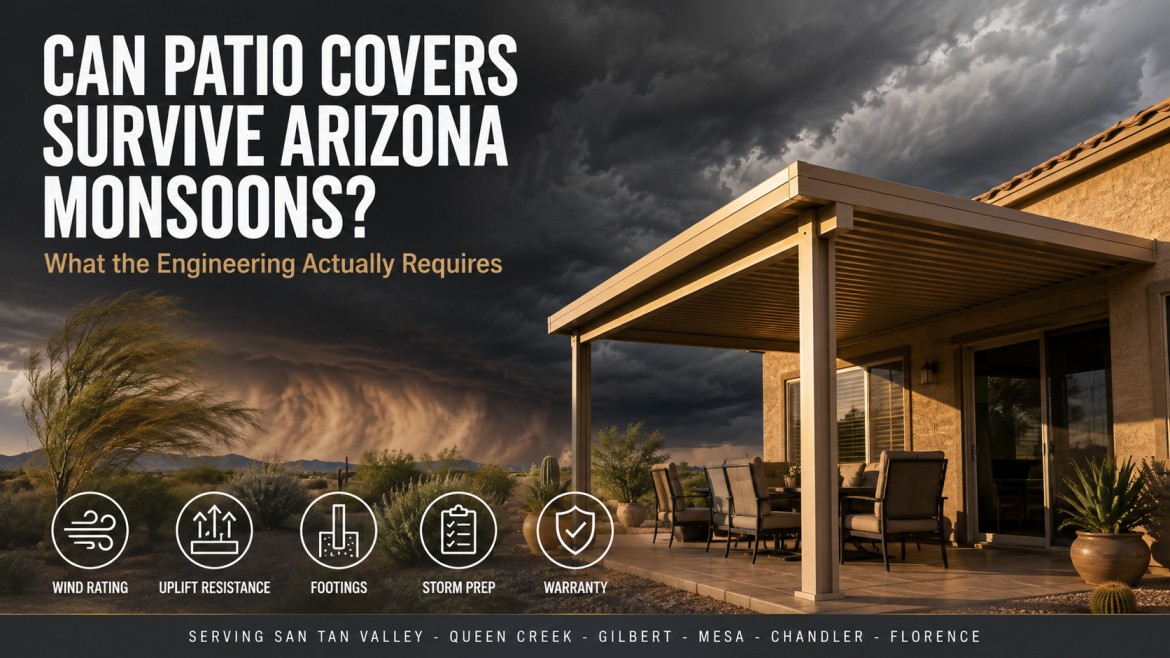
Can Patio Covers Survive Arizona Monsoons? | Arizone Guide
Can Patio Covers Survive Arizona Monsoons?
Quick Answer: Yes, when they are engineered and permitted properly. Arizona jurisdictions generally require patio covers to be designed for a 115 mph ultimate wind speed — well above the 50 to 64 mph gusts typical of East Valley monsoon storms. Failures almost always trace back to shallow footings, undersized beams, or unpermitted work.
What Do Arizona Monsoon Storms Actually Do to a Patio Cover?
Monsoon season runs from June 15 through September 30 by the National Weather Service definition, though the storms themselves arrive on their own schedule. Three forces do the damage, and they work differently.
Straight-line wind is the headline. Outflow from a collapsing thunderstorm — a microburst — hits the ground and spreads outward fast. During one representative East Valley event, Phoenix Sky Harbor recorded a 64 mph gust while outflow from Pinal County storms pushed gusts past 50 mph across the East Valley, downing trees in Scottsdale, Tempe, and Ahwatukee.
Uplift is the force homeowners never think about and engineers design around first. Wind moving across a patio cover does not just push down — it accelerates over the surface and generates negative pressure above, effectively trying to lift the roof off its posts. A structure can be strong in compression and still fail in uplift if the connections are wrong.
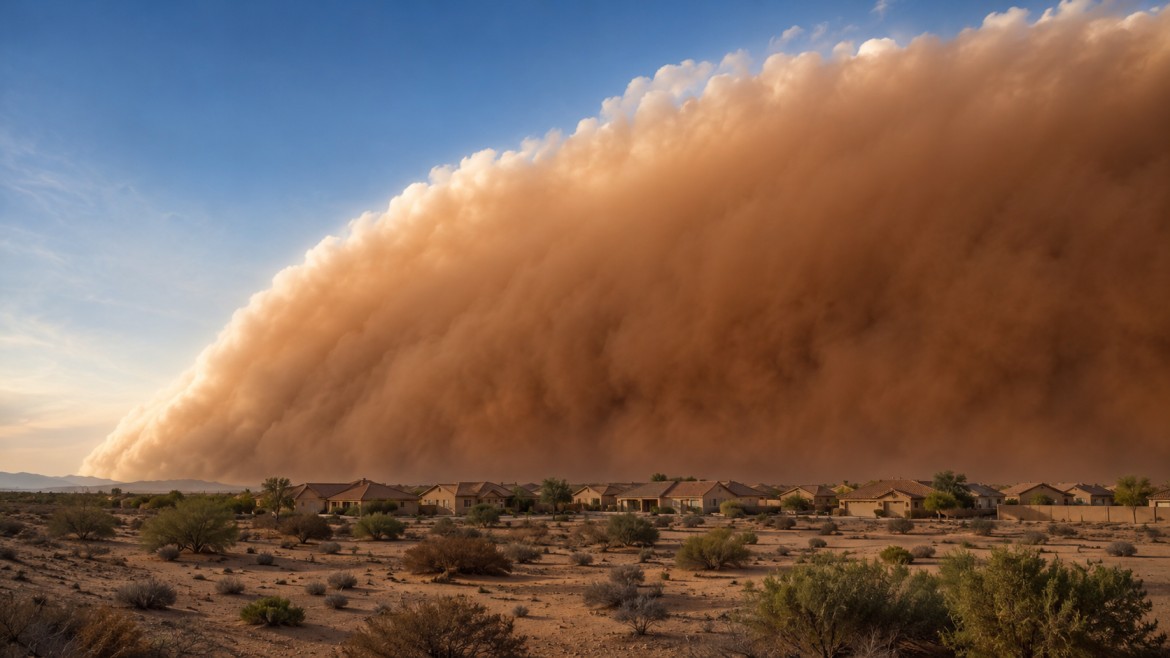
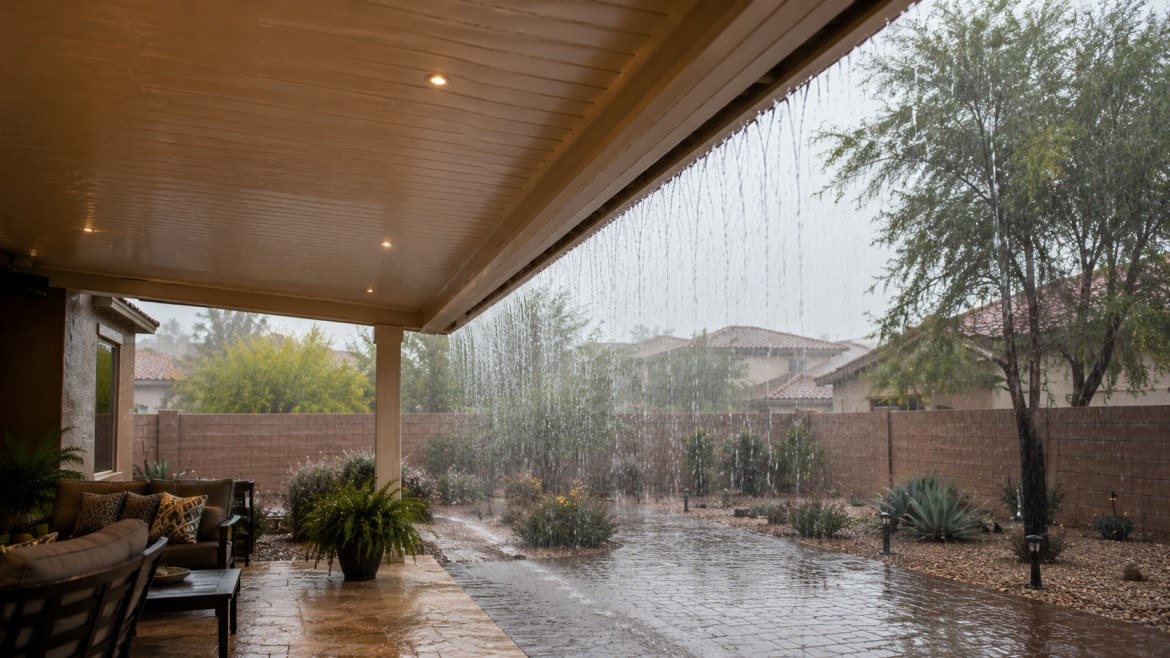
Water and dust finish the job. Half an inch of rain in thirty minutes is common, and driven sideways it finds any gap in flashing where an attached cover meets the house. Haboobs push a wall of dust ahead of the storm — some 3,000 feet tall — packing grit into gutters and fastener seams.
None of this is unusual here. It is the normal operating environment, and precisely why the building code is written the way it is.
How Are Patio Covers Engineered to Handle Monsoon Winds?
The short answer is that code requires a very large safety margin over what the weather actually delivers.
Municipalities across Maricopa County generally require patio covers engineered for a 115 mph ultimate design wind speed under ASCE 7-16 and the 2021 building code. Set that against measured monsoon gusts of 50 to 64 mph and the margin is clear. A properly engineered structure is not built to survive a typical storm — it is built well past the worst on record.
That margin gets delivered through four things:
Footings. Post bases must reach undisturbed soil rather than sit on a slab. Chandler, as one example, specifies a minimum footing of 18 inches square and 12 inches deep below grade.
Uplift-resistant connections. Wind-rated fasteners and hardware engineered to resist negative pressure, not just downward load. This is where cheap installations fail first.
Beam sizing and span limits. A 2×8 beam typically spans up to about 12 feet under standard conditions. Push a beam past its rated span to save on posts and you have quietly removed the safety margin.
Cross-bracing. Resists the racking motion that lateral wind puts into a structure standing on posts.
Certification matters too. Reputable aluminum patio covers carry ICC-ES evaluation reports confirming compliance with the international building and residential codes — evidence the system was tested, not merely assembled.
Which Patio Cover Styles Hold Up Best in a Storm?
All of them perform well when engineered correctly, but they behave differently.
Solid and insulated patio covers present the largest continuous surface to the wind and therefore the highest uplift loads, which the engineering answers with more attention to footings and fasteners. Done right they are extremely robust, and they are the only styles that keep you dry in a downpour. Insulated panels also dampen the drumming of heavy rain overhead.
Lattice patio covers let wind pass through the gaps, so they generate less uplift than an equivalent solid roof. They offer no rain protection at all, which is a fair trade in a garden or over a pool deck.
Louvered patio covers are the most adaptable. Blades can be closed against driving rain and, on many systems, opened to let wind pass through rather than push against a sealed surface. Check what the manufacturer recommends for high-wind events, because guidance varies by system.
Attached versus freestanding matters less than people assume. An attached cover has one seam against the house that must be flashed correctly or it leaks. A freestanding patio cover has no seam but carries all its wind load on four posts, so its footings do more work. Neither is inherently safer.
Weighing the options for your own yard? Browse our homeowner guides and project stories for detailed comparisons across every style we build.
Why Do Some Patio Covers Fail During Monsoon Season?
The storm is rarely the real cause. It is the test that reveals one already there.
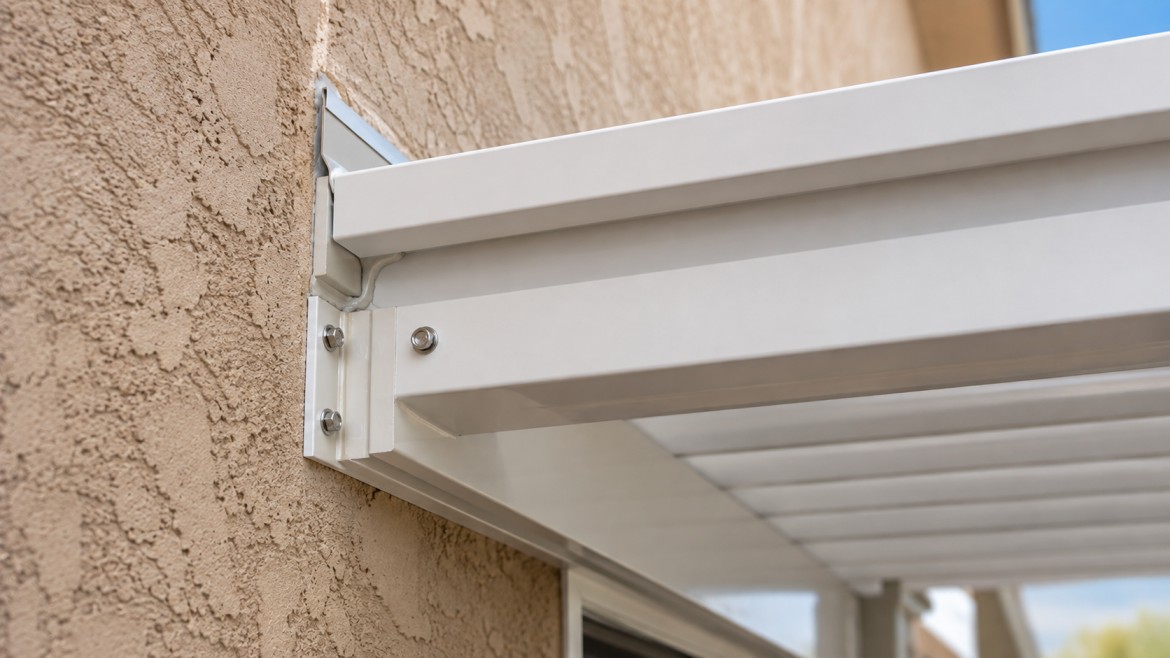
Fasteners into stucco instead of structure is the failure we get called out to fix most often. Stucco is a finish, not a framing member. An attached cover anchored into it holds fine in still air and lets go the first time a microburst pulls upward on the roof.
Shallow or undersized footings come next. Posts set in a few inches of concrete, or bolted to the surface of an existing patio slab, have nothing meaningful resisting uplift. This is the defect that footing inspections exist to catch — and precisely what an unpermitted build skips.
Then there are overspanned beams. Stretching a beam past its rated span to eliminate a post saves a few hundred dollars and quietly deletes the engineering margin the code intended.
Neglected maintenance contributes too. Blocked gutters let water pool and add load, and loose fasteners nobody has checked in six years work further loose with every storm.
The common thread is that all four are invisible from a patio chair. They are also all avoided by the same thing: permitted, engineered, inspected installation by a licensed patio cover contractor in Queen Creek or wherever you happen to live in the valley.
How Should You Inspect and Prepare Your Patio Cover?
A quality aluminum structure asks very little of you. What it does ask is worth doing before June rather than during August.
Once a year, ideally in late spring, check five things: fasteners at the ledger and post connections for movement, gutters and downspouts for debris, flashing for gaps or lifted sealant, post bases for erosion or standing irrigation water, and panels or louvers for anything loose.
Before a storm, the highest-value move has nothing to do with the structure itself. Secure what is under it. Umbrellas, lightweight furniture, and shade sails become projectiles in a 60 mph gust and do more damage to a cover than the wind does. Retract awnings, close louvers per manufacturer guidance, bring cushions in.
After a storm, look for new gaps at the roofline, water staining on the underside of panels, and any post that no longer looks plumb. Small movement is worth a call — it rarely fixes itself.
Warranty terms earn their keep here. Coverage on both materials and labour makes a storm-related defect a phone call rather than a negotiation.
Not sure whether your existing cover was built to code? Schedule a free consultation and estimate and we'll take a look before the next storm does.
Frequently Asked Questions
Can a patio cover withstand 60 mph winds?
A properly engineered one, comfortably. Arizona jurisdictions generally require patio covers designed for a 115 mph ultimate wind speed, roughly double the 50 to 64 mph gusts measured in typical East Valley monsoon storms. The caveat is that the margin only exists if footings, fasteners, and beam spans were built to the approved drawings.
Do patio covers leak during monsoon storms?
They should not. Leaks in an attached patio cover almost always come from the seam where the structure meets the house — missing flashing, failed sealant, or fasteners driven into stucco rather than framing. Driven rain finds those gaps immediately. A correctly flashed connection stays dry through a full monsoon season.
Should I close or open my louvered patio cover during a storm?
Follow your manufacturer guidance, because systems differ. Many louvered patio covers are designed to be closed against driving rain, while some recommend opening the blades in high wind so air passes through rather than pushing against a sealed surface. Motorised systems often include a wind sensor that handles it automatically.
Does homeowners insurance cover monsoon damage to a patio cover?
It depends on your policy and how the structure was built. Permitted, engineered improvements are generally treated differently from unpermitted ones, and coverage terms vary considerably between carriers. This is a question for your insurance agent rather than your contractor — and worth asking before you build, not after a storm.
When is monsoon season in Arizona?
The National Weather Service defines it as June 15 through September 30, though the first real storm varies year to year. Schedule any patio cover inspection or repair for spring, ahead of the season. Installation during monsoon months is possible but weather delays are more likely between July and September.
