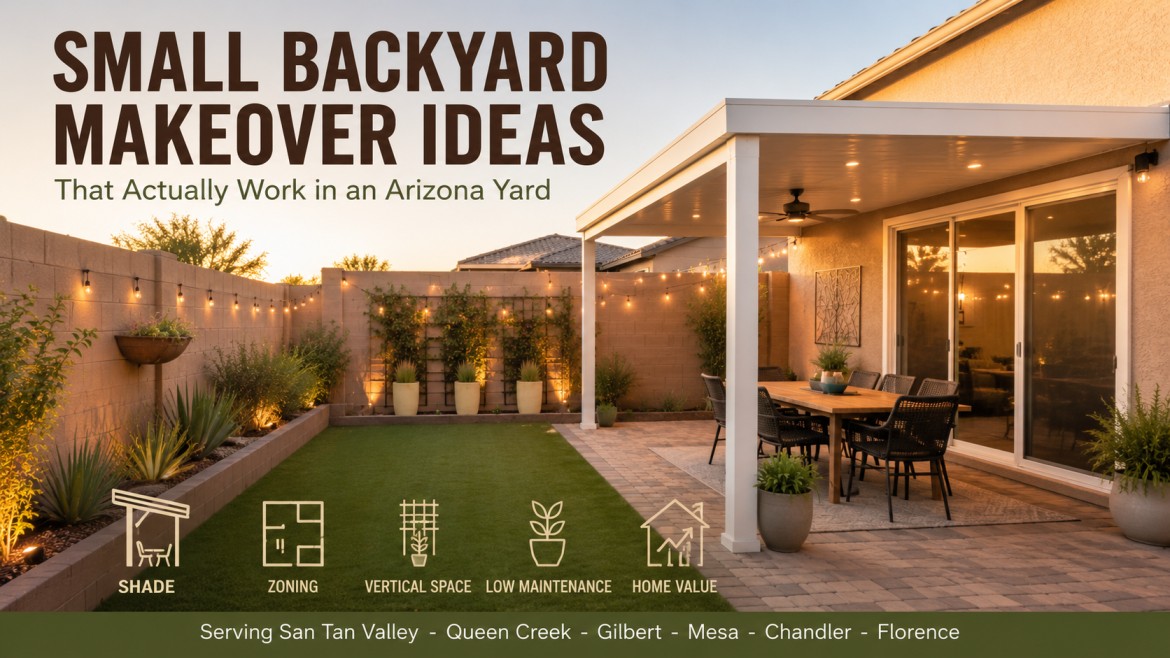
Small Backyard Makeover Ideas for Arizona Homeowners
Small Backyard Makeover Ideas That Actually Work in an Arizona Yard
Quick Answer: The highest-impact small backyard makeover ideas in Arizona are adding a proportioned shade structure, committing to two well-defined zones instead of four cramped ones, building vertically along block walls, and choosing one strong focal point. Shade comes first — without it, a small desert yard goes unused from May through September.
What Makes a Small Arizona Backyard Feel Bigger?
Almost every new build going up in Queen Creek, San Tan Valley, and Gilbert trades yard for square footage indoors. It's now common to walk into a backyard ten or fifteen feet deep, walled on three sides, with barely five feet between the house and the neighbor's block wall. That is the canvas most of our customers are working with.
The instinct is to keep everything low and small so the space doesn't feel crowded. That backfires. A yard of short, scattered elements reads as cluttered, not spacious.
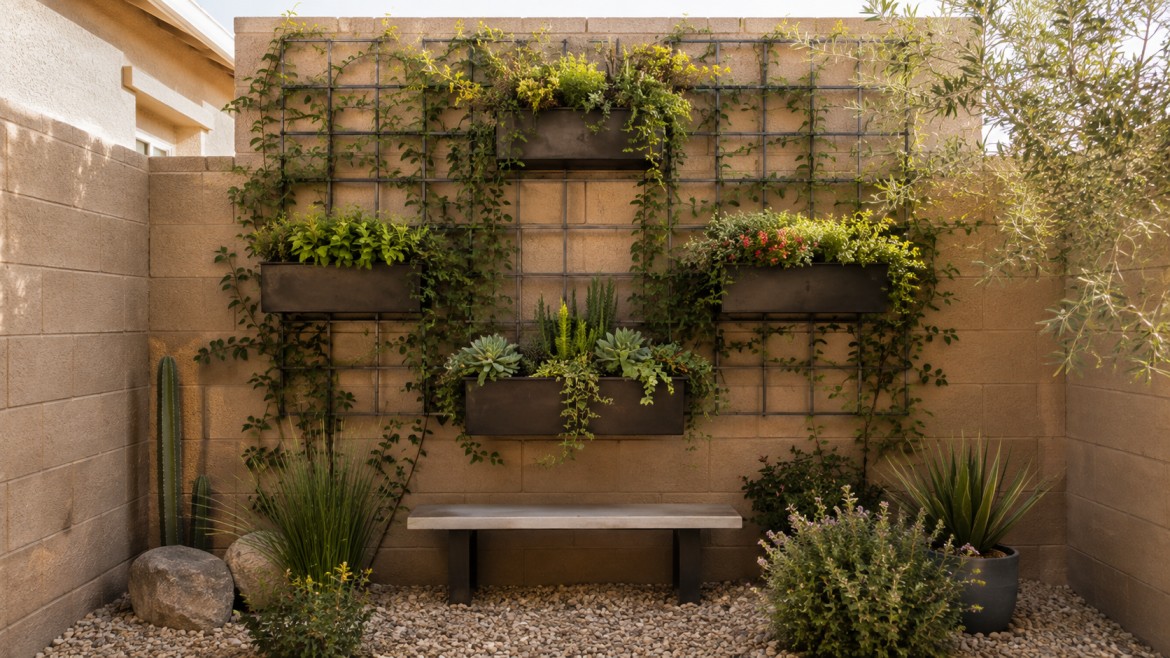
What actually opens up a small yard is height. A backyard shade structure with real presence — proper columns and a defined roofline — pulls the eye up and away from the fence line, the same way a tall bookcase makes a small room feel taller. Trellises, wall-mounted planters, and layered planting against block walls do the same job at smaller scale.
The second move is subtraction. Pick one focal point and let everything else support it. Small yards fail when they try to be five things at once.
Third, break the boxiness. Running pavers diagonally across a rectangular yard, or angling a patio a few degrees off the house, creates a longer sightline than a straight run and makes the same footprint feel deeper.
Which Small Backyard Makeover Ideas Deliver the Most Shade?
In this climate, shade is not a design preference. It is the difference between a yard you use and a yard you look at through the window.
The challenge in a small yard is proportion. A structure sized for a half-acre lot will swallow a fifteen-foot-deep patio and read like a carport. The options that work here are scaled deliberately:
An attached patio cover spanning the width of the house consumes no floor space — it borrows the wall and covers the whole usable strip.
A lattice patio cover or slim pergola keeps overhead light coming through so a narrow yard doesn't go dim.
A louvered patio cover gives full shade at 4 p.m. and open sky at 7, which matters more when you only have one outdoor room.
Awnings and retractable shades handle a side yard or west-facing window with no posts on the ground at all.
Block walls make the problem worse than square footage suggests. Three walls soak up sun all day and radiate it back after sunset, so a small walled yard runs hotter than an open one the same size. Shading the walls, not just the seating, is what breaks that cycle.
For genuinely tight spaces, a sunroom or liferoom converts the patio into enclosed, conditioned square footage. You trade the open-air feel for a room the family uses twelve months a year.
Looking for more ideas scaled to East Valley lots? Browse our homeowner guides and project stories for real examples.
How Do You Fit Everything You Want Into a Small Yard?
Think in zones, not layouts.
Write down what you actually want to do out there, in order: dine, lounge, grill, let the dog out, sit by a fire. Then be honest about how many fit. In a yard under a thousand square feet you get two zones done well, or four done badly.
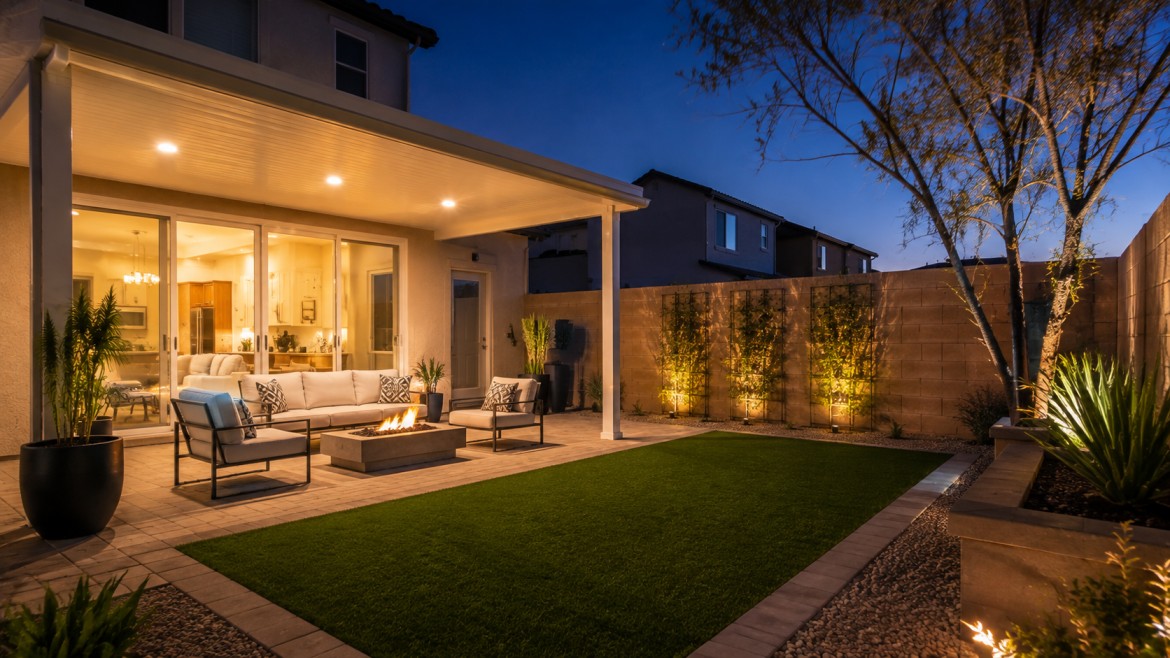
The pairing that works most often in East Valley yards is a covered dining and seating zone against the house, plus one small open zone beyond it — turf for kids and dogs, or a compact fire pit. Everything else becomes planting or storage.
A few moves that buy space back:
Built-in bench seating along a block wall instead of freestanding chairs, which recovers two to three feet of circulation.
A narrow built-in grill counter rather than a full outdoor kitchen island.
Artificial turf instead of gravel in the open zone, so it reads as usable space rather than leftover space.
Lighting integrated into the patio cover posts and beams, eliminating floor lamps and stake lights.
Circulation is what homeowners forget. You need roughly three feet to walk comfortably behind a seated dining chair. Design the paths first, then place the furniture — not the other way around.
What Materials Hold Up Best in a Small Desert Yard?
Small yards punish bad material choices, because you are looking at everything from six feet away.
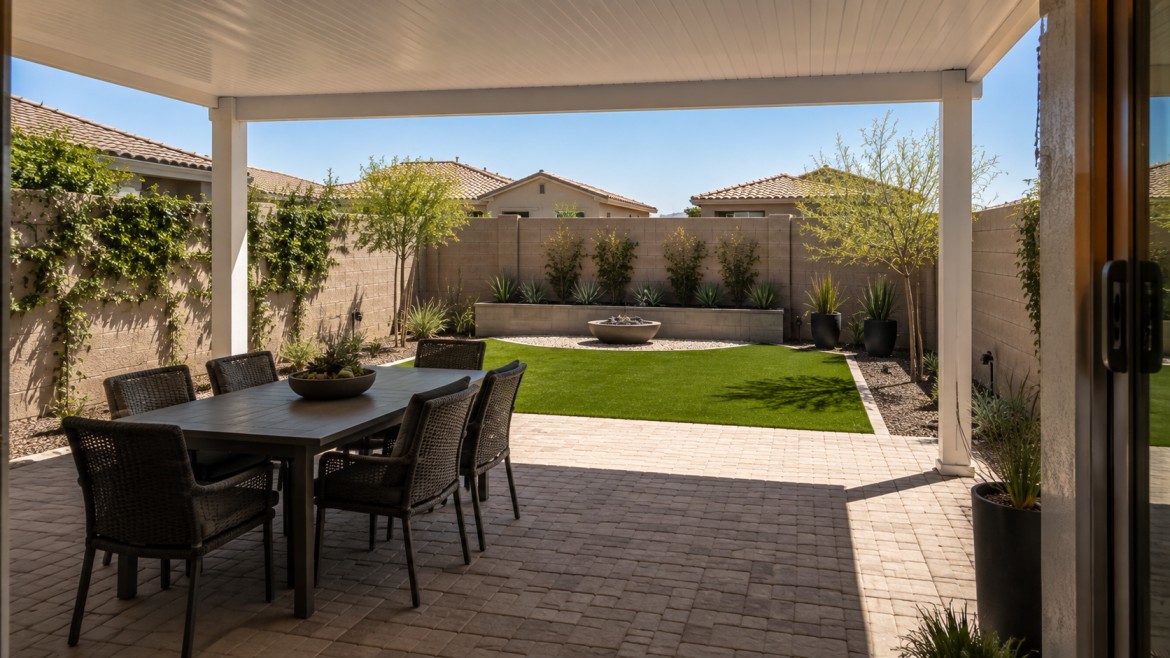
Aluminum patio covers have taken over the East Valley for reasons that suit compact spaces especially well: no warping at 115 degrees, no termites, no repainting every few years, and slim structural profiles that do not visually crowd a small patio. Wood beams spanning the same distance are noticeably bulkier overhead.
Within aluminum, the choice matters more here than on a large lot. Insulated patio covers stop radiant heat from a hot pan roof, which you feel far more sitting eight feet beneath it than twenty. Lattice patio covers preserve daylight in a narrow yard. Polycarbonate patio covers pass light while blocking UV, keeping a small covered patio from feeling like a cave.
On the ground, pavers and stamped concrete both work well. Loose gravel is the one to reconsider when the walk from patio to back door is fifteen feet — it tracks indoors constantly.
Maintenance matters disproportionately too. A small yard is visible from nearly every window in the house, so anything that fades, flakes, or needs annual sealing becomes an irritation fast.
Not sure which system fits your yard? Schedule a free consultation and estimate and we'll bring samples out to you.
Which Small Backyard Upgrades Actually Add Home Value?
Not all of them, and the gap is wide.
Buyers touring homes in Mesa, Chandler, and Casa Grande in June run one calculation: can I use this yard? A small yard with a permanent covered patio answers yes. A small yard with a patio umbrella and a gravel field does not, however nicely it is staged.
Permanent, permitted structures carry value in a way furniture and decor never do. A properly engineered custom patio cover appears in appraisals and listing photos and stays with the house. Retractable shades, portable fire pits, and container plants leave with you.
The second value driver gets underestimated: usable outdoor space shapes how a home shows even when it adds nothing to appraised square footage. A 1,900-square-foot home with a genuinely comfortable 300-square-foot covered patio shows better than a 2,100-square-foot home with nothing outside.
The advantage in a small yard is that the whole thing is achievable at once. You are not landscaping an acre — one well-placed structure often transforms the entire space in a matter of weeks.
Whether you are planning a full backyard makeover in Queen Creek or just want the patio usable by next summer, talk with our team about your backyard and we'll design something proportioned to the yard you actually have.
Frequently Asked Questions
What is the best small backyard makeover idea for an Arizona home?
Shade first, every time. A proportioned patio cover turns an unusable summer yard into the most-used room in the house. Once shade is handled, the highest-value additions are defined zones, vertical planting against block walls, and integrated lighting. Landscaping alone rarely makes an Arizona yard comfortable between May and September.
How much space do I need for a patio cover in a small backyard?
Less than most homeowners assume. A ten-foot projection off the house comfortably seats a dining table for six, and an attached patio cover uses no floor space for a house-side wall. Even a twelve-by-sixteen covered area creates a genuine outdoor room in a yard under 1,000 square feet.
Can I add a patio cover to a backyard that is only 10 or 15 feet deep?
Yes, and shallow yards are some of our most common projects across Queen Creek and San Tan Valley. An attached patio cover works best here because it needs only two posts at the outer edge. We size the projection to leave walking clearance between the posts and your block wall.
Do small backyard upgrades need HOA approval in Queen Creek?
Permanent structures usually do. Most master-planned communities require architectural approval for patio covers, pergolas, and sunrooms, and the town requires a building permit for anything attached to the home. A licensed patio cover contractor should prepare the HOA packet and handle permitting for you.
What is the most affordable way to make a small backyard usable?
Start with a straightforward solid aluminum patio cover over your existing slab, then add lighting and a ceiling fan during the same build while the wiring is open. That combination delivers most of the comfort gain. Turf, planting, and furniture can follow later without redoing any of the structural work.
